.png)
10 Things to Know Before Traveling to China (Chongqing and Guizhou Guide)

Updated: Apr 15
I didn’t expect China to surprise me — but it did, almost instantly.
To be honest, it was never at the top of my list. But when the opportunity came up, of course, you say yes. I thought I knew what I was walking into: big cities, overwhelming crowds, and something completely unfamiliar — like many people from the United States and other Western countries might imagine.

And while that part is true, what I didn’t expect was how advanced, efficient, and, in many ways, surprisingly easy daily life would feel once I arrived. From the moment I landed, I realized this wasn’t just another destination — it’s a completely different system, a different rhythm, and a way of living that challenges everything you think you know about travel.
What to Know Before Traveling to China: A First-Time Guide
This was my first trip to China, and it completely shifted my perspective.
If you're wondering what to know before traveling to China, this guide will walk you through the biggest surprises that aren't what you'd expect. From mobile payments to daily convenience, these small details - especially in cities like Chongqing- make all the difference.
In this guide, I’ll walk you through the key experiences, practical tips, and the biggest surprises I encountered along the way — so your first visit to mainland China can feel far less overwhelming and much more seamless.
1. Must-Have Apps to Know Before Traveling to China
Once you have your flight booked, start downloading your must-have apps.
China runs on mobile technology, and without the right apps, simple things like paying, ordering food, or calling a ride become difficult.
Here’s what you need:
WeChat
Alipay
Amap (their maps app), but Apple Maps will also get you around
DiDi China (ride-hailing)
Google Translate (download offline Chinese)
Trip.com - to book trains
A translation app like Google Translate will help you navigate the language barrier, especially since most places (a good 95% of them) don’t have an English version available. Hate to break it to you, but now is the time to let go of that expectation of people knowing and understanding English.
Very important! Set everything up before arrival — especially your payment methods. This is especially important because you need to receive a confirmation code to a phone number, and your eSIM won't necessarily have a number associated with it. You can use your cell number from your home country, receive the confirmation code, and then be all set once you set foot into China.
External Chargers
Even though we thought we had everything set up, there was one thing that did not work for us. Although we had WeChat downloaded, we were unable to "scan out" external chargers. You'll see throughout the cities cubes filled with external chargers (anywhere from 10 to 20 in a cube). These have a QR code on them, and when you use the scanner from your WeChat app, you can access these chargers at a fraction of the price to charge your phone.
This is particularly important as bringing external chargers into China is a big no-no. They are very strict with them. You can bring a smaller one in, but don't be surprised if you get stopped. That said, there are chargers everywhere, but we had trouble accessing them due to needing to receive another verification code.
However! How to solve this issue? If we seriously needed a charger, we asked a Chinese person to scan one out for us, and then we paid them with WeChat Pay or Alipay to their QR code (there's a solution for everything in China).
2. Cash Is Almost Irrelevant
One of the biggest surprises during my first time in China was how little cash I needed.
In many countries, you still use a credit card or carry a small amount of cash. But in China, mobile payments are the common practice.
Everything works through a QR code system:
coffee shops
taxis
street food vendors
even local markets
You scan and pay.
Even if you have a credit card or bank card, you won't use it directly because you have to scan the QR code or they scan yours through WeChat or AliPay.
A small amount of cash is still a good idea to bring with you (USD or Euro), and to exchange in China. But it’s definitely not the best option for everyday use. The cash will most likely be used if you're in an area with poor cellular service and your QR code is not working properly; then, cash is good to have, but other than that, cash is nonexistent.
3. Internet Access & The Great Firewall
This is something many first-time visitors don’t realize until they arrive.
Due to what's commonly known as the Great Firewall in China, many apps from the United States and Europe don’t work as you might expect. This includes:
Google
Gmail
Instagram
Tiktok
Youtube
WhatsApp
Google Maps
This affects your internet access and social media usage.
To stay connected, you’ll need:
A VPN (download BEFORE arrival) - this will allow you to stay connected to all the apps that you use daily
An eSIM - I always get mine from MobiMatter, and for 10 days in China, I bought a 50GB eSIM for $30 USD, valid for 30 days, with plenty left over. And I was on my phone using data constantly for translating, looking things up, posting to Instagram, and as a personal hotspot for my laptop. I did not connect to any wifi while in China.
or A local SIM card
A local SIM card can help you stay connected in China’s major cities and open the door to apps where you need a Chinese phone number (particularly for apps that offer discounts for certain restaurants, etc.). This is great if you're staying for a longer period of time. But convenience-wise, getting an eSIM makes it easier to be connected as soon as you get off the plane. Especially if you haven't filled out your visa on arrival, you'll need internet access to fill that out.
4. High-Speed Trains Are the Best Way to Travel
China’s high-speed rail network is one of the most impressive things I’ve ever experienced.
If you’re planning a China tour between cities, or even something smaller like Chongqing and Guiyang, or between any city, the best way to travel is by high-speed trains, not domestic flights.
Trains are fast
Train stations are modern and organized
Booking train tickets is simple
I took a high-speed train, and honestly, it felt smoother than flying. But some things to keep in mind when going to the train station. Get there sooner! As a foreigner, you will need to show your passport each time (for entry into the station, boarding the train, and exiting the station) at the train station. They do have a security belt where you put not only your suitcase through, but you also go through security like at an airport.
Then, right before heading down to the tracks to board the train, you will need your passport again. Your passport is basically your ticket as a foreigner. Make sure you give yourself enough time, as it can be hectic, and the crowds are big. A heads up, the line where you can show your passport will always be on one of the ends and never in the middle, where everyone else can go through.
All in all, public transportation in China — especially high-speed rail — is extremely efficient and extremely big.
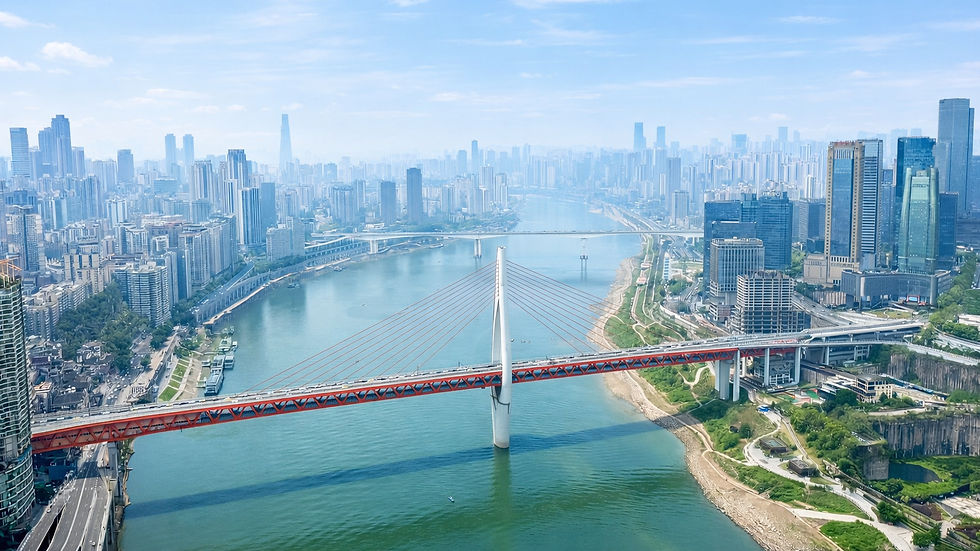
5. The Cities Feel Like the Future
The main city that I was in as a first-time visitor to China was Chongqing. But even the smaller cities that I visited were unlike anything else I've ever visited.
In places like Chongqing:
Buildings are layered on top of each other
Different cities start on different stories
Metro stations connect entire city centers
Trains run through buildings
Large shopping malls are everywhere
It feels futuristic, overwhelming, and fascinating at the same time. Some parts of the city you're able to compare to something you've seen before (like the malls feeling like that in Brickell, Miami, and then the skyscrapers surrounding you like those in Manhattan), but everything else you're just staring at and trying to absorb it all. Attempting to understand what all this overwhelming chaos is.
China’s major cities are not just destinations — they’re experiences.
6. Culture Shock Is Real (But That’s the Point)
I've been to other asian countries, and there are some similarities between them, but China is different. China is a completely different world of its own, and you will feel it.
Some things that stood out to me:
Different bathroom standards - the bathrooms in China require a full different blog post. Squat toilets are more common than I would have expected. The search for a western toilet in some areas feels like you're searching for a pin in a haystack, but when you do find one, it's like hitting the jackpot! But in some places you will find a handicap toilet, which is a western toilet, but don't always bank on one! And also don't forget to bring toilet paper with you!
Common squat toilets in China Occasional western toilets in China
Limited personal space in crowded areas - I don't know about you, but I like my personal space. Not in China. The elevator says max 14, people? You will definitely have an elevator filled with 14 people, and questioning how you all fit in here. They all pile in as if it's completely fine.
Strong local customs - such as sharing food is the norm, the local hot pot culture, crowds can be overwhelming, and the hospitality is something that I've never experienced. It's generous, abundant, and very real (but another post on that later).
A noticeable language barrier - don't expect people to know English. If you go to a larger chain hotel, they will know basic English, but at a Chinese-branded hotel, not only will they not speak English, but nothing within the hotel will have anything written in English (you really have your phone translating for you 24/7)
But this is also what makes the experience so unique.
The key is to go in with an open mind and not have expectations.
7. Chinese Food Is Not What You Expect
If you think you know Chinese cuisine, think again.
Chinese food in China is:
more diverse
more regional
In certain regions, the spiciest
more fruits and vegetables
healthier than I imagined
desserts are less sweet
In cities like Chongqing, food culture is bold and intense.
Street food is everywhere, and eating is a social experience — dishes are shared, not individual. What also surprised me is how much variety there is depending on the region. What you eat in Chongqing can be completely different from other parts of China. Even simple meals feel intentional, fresh, and balanced, with a strong focus on ingredients rather than heavy sauces. It’s one of those things you don’t fully understand until you experience it — Chinese cuisine isn’t just food, it’s a reflection of culture, community, and daily life.
Traditional Hotpot meal Sharing meals is part of the culture Sweet treats are absolutely delicious
Chinese food is a huge part of daily life and cultural identity.
8. It’s Much More Diverse Than You Think
Before visiting, I imagined mostly big cities.
But China also has:
small towns
rural areas
natural landscapes
From waterfalls at a coffee shop location to river cruises, the diversity is incredible — even extending to impressive structures like some of the tallest bridges in the world, blending nature and modern engineering in a way you don’t often see.

What I didn’t expect was how quickly the scenery can change — one moment you’re surrounded by skyscrapers in a major city, and the next you’re in a completely different environment filled with greenery, mountains, or quiet local neighborhoods.
Even within the same region, you experience different lifestyles, from fast-paced city centers to slower, more traditional areas. It made me realize that China isn’t just one type of destination; it’s many different experiences (nature, culture, and modern life) all within one country.
9. Timing Matters (Best Time to Visit)
The best time to visit China depends on your travel style.
Avoid:
Chinese New Year
national holidays
public holidays
These are peak travel times for Chinese people to travel within their own country, and this means huge crowds. I happened to be in Chongqing on the weekend of one of their national holidays, and the crowd at the Hongya Cave was a lot.
Hongya Cave at night Hongya Cave at night the crowd for the Hongya Cave
Apparently, that's the crowd normally there, but having it be a national holiday too added a few more people to the already large crowd.
For a smoother experience:
Spring and autumn are ideal
better hotel rates
fewer crowds
Timing really impacts your entire experience more than you might expect. During peak periods like Chinese New Year or national holidays, everything becomes more crowded — from train stations to tourist attractions, and travel can feel overwhelming if you’re not prepared. On the other hand, visiting during quieter months allows you to enjoy the same places at a much more relaxed pace, with easier transportation, better availability, and a more enjoyable overall experience. Another great time to see the bigger cities is earlier in the morning, from 7:00 am to 10:00 am. Crowds are smaller, and you get to experience the city while it's a little quieter.
10. Visa & Entry (Good News for Travelers)
Depending on your nationality, there are now more flexible entry options available, including:
China visa-free policies
even a 30-day visa-free entry in certain cases
which is great news for first-time visitors. That said, the rules can change and vary depending on your passport, so it’s always important to double-check the latest visa requirements before your trip.
For my trip, when I landed, I had to scan a QR code, fill out a few questions that included the purpose of the trip, where I was staying, when I was leaving, and exit flight details. It was quick and easy to fill out, then you stand in line, have it checked over, and get your stamp.
But always check:
visa requirements
tourist visa rules
Chinese embassy updates
It’s also a good idea to have all your documents organized ahead of time (hotels, hotel address, exit flight details, etc.), so your arrival goes as smoothly as possible. And one thing I wouldn’t skip — travel insurance is a must, especially when traveling somewhere that operates a bit differently than what you may be used to.
Final Thoughts
China is not what you expect — and that’s exactly why you should go!
From high-speed trains to mobile payments, from local markets to futuristic city centers, everything works differently, but incredibly well.
It challenges your perspective, changes how you see daily life, and shows you a world that operates on a completely different system.
And honestly? That’s what makes it unforgettable.
In another blog post, I'll share a deeper look into specific cities like Chongqing - along with must-see spots, hidden gems (like a coffee shop next to a waterfall that even many locals haven't even been too), and exactly how to plan your itinerary!


Bài bạn viết ngắn gọn mà dễ hiểu thật, mình đọc một lượt là nắm được ý, cảm ơn bạn đã đăng nhé. Mình cũng có thói quen xem thống kê XSMB hằng ngày, nhưng hồi trước cứ phải mở vài nguồn khác nhau để so sánh nên hơi mất công. Về sau mình chuyển sang tự ghi chú và gom lại một chỗ cho tiện, kiểu lưu trên soicau247.com để khi cần chỉ việc mở ra là xem lại ngay. Mình chủ yếu quan tâm dữ liệu cập nhật theo ngày, nhìn lại cho nhanh chứ không làm gì phức tạp. Nếu ai cũng hay theo dõi giống mình thì có thể xem thêm ở đây: https://soicau247.com/lo-top.html.